Greater Than or Equal To
What Is the Greater Than or Equal To Operator?
- The
>=operator in Python is used to check if a value is greater than or equal to another value.
How to Use It:
The basic way to use this operator is:
pythonresult = value1 >= value2value1andvalue2are the values you want to compare.resultwill beTrueifvalue1is greater than or equal tovalue2, andFalseif not.
Examples and Exercises:
Comparing Numbers:
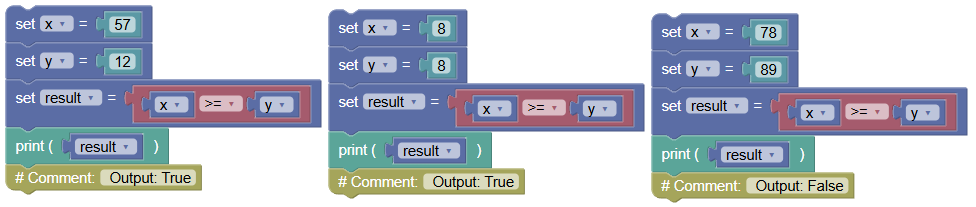 python
x = 57 y = 12 result = x >= y print(result) # Output: True x = 8 y = 8 result = x >= y print(result) # Output: True x = 78 y = 89 result = x >= y print(result) # Output: FalseComparing Sequences:
- You can compare lists, strings, or tuples using the
>=operator.
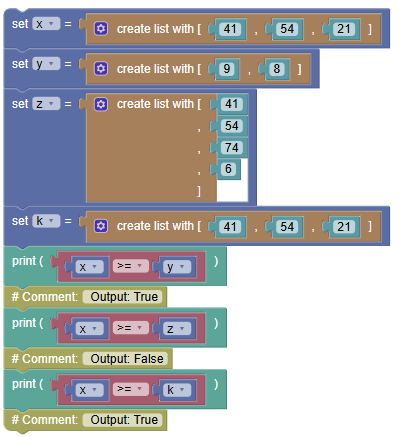 python
x = [41, 54, 21] y = [9, 8] z = [41, 54, 74, 6] k = [41, 54, 21] print(x >= y) # Output: True print(x >= z) # Output: False print(x >= k) # Output: True- You can compare lists, strings, or tuples using the
Summary:
- The
>=operator in Python helps you determine if one value is greater than or equal to another. It works with numbers and sequences like lists and strings. Try the examples to see how it works!