AND
What Is the AND Operator?
- The AND operator
andin Python is used to check if both conditions in a statement are true.
How to Use It:
The basic way to use the AND operator is:
pythonresult = condition1 and condition2condition1andcondition2are the conditions you want to compare.resultwill beTrueonly if both conditions are true.
Truth Table:
Here’s how the AND operator works with different conditions:
Operand1  Operand2  Return Value
True      True      True
True      False     False
False     True      False
False     False     False
Examples and Exercises:
Using AND with Boolean Values:
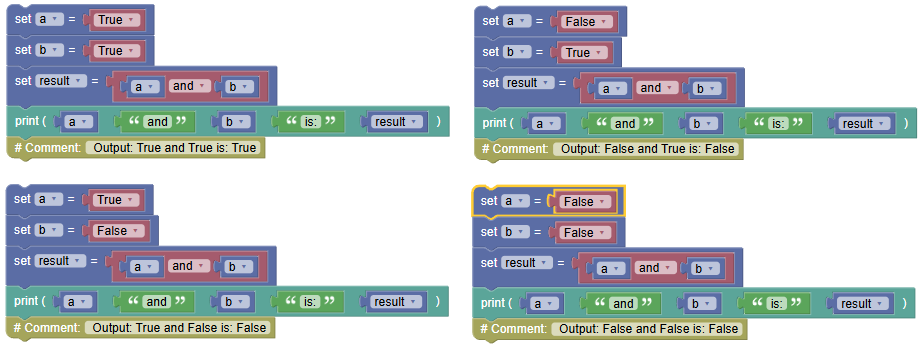 python
a = True b = True result = a and b print(a, 'and', b, 'is:', result) # Output: True and True is: True a = True b = False result = a and b print(a, 'and', b, 'is:', result) # Output: True and False is: False a = False b = True result = a and b print(a, 'and', b, 'is:', result) # Output: False and True is: False a = False b = False result = a and b print(a, 'and', b, 'is:', result) # Output: False and False is: FalseUsing AND with Non-Boolean Values:
In Python, you can use numbers in place of boolean values (0 is False, any other number is True).
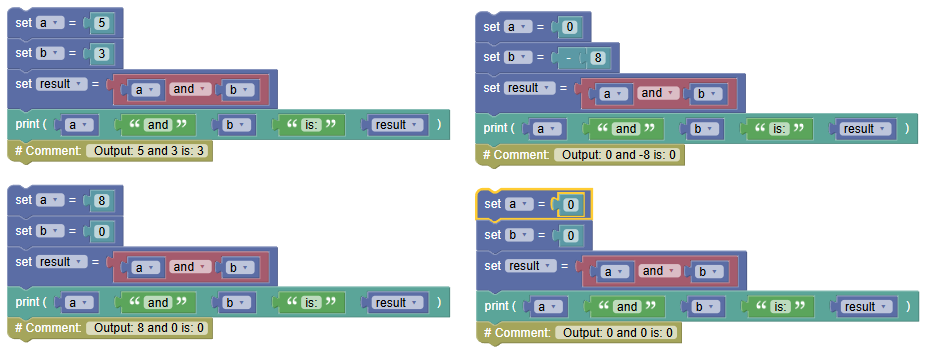
pythona = 5 b = 3 result = a and b print(a, 'and', b, 'is:', result) # Output: 5 and 3 is: 3 a = 8 b = 0 result = a and b print(a, 'and', b, 'is:', result) # Output: 8 and 0 is: 0 a = 0 b = -8 result = a and b print(a, 'and', b, 'is:', result) # Output: 0 and -8 is: 0 a = 0 b = 0 result = a and b print(a, 'and', b, 'is:', result) # Output: 0 and 0 is: 0
Summary:
- The AND operator
andin Python allows you to check if two conditions are both true. It’s useful for making decisions in your code. Try the examples to see how it works!